If you’ve ever wondered what makes an open-type generator set run quietly, efficiently, and without turning your work area into a stinky, smoky mess, let’s talk about one of its most unsung parts: the exhaust system. As a supplier of open-type generator sets, I get asked all the time, “Why does the exhaust matter so much, and how is this different from a regular car exhaust?” I’m not here to bore you with jargon, but understanding this part is key to picking the right generator for your job—whether you’re powering a construction site, a warehouse during a grid outage, or a temporary event space. Open-type Generator Set
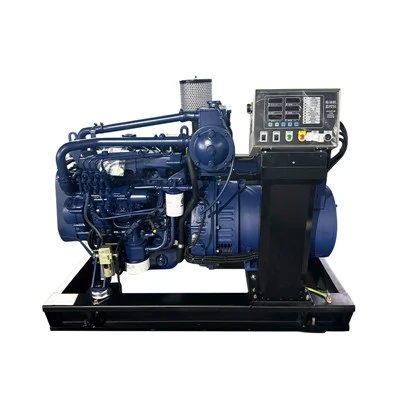
First, let’s keep it simple: an open-type generator set isn’t the enclosed, sound-dampened box you might see at a campground. It’s the frame-mounted unit with the engine, alternator, and all parts exposed (or sometimes just covered by a basic metal guard) to make maintenance easier and costs lower. That openness means every system has to work extra hard to control exhaust, because there’s no enclosed shell to trap or muffle fumes. The exhaust system’s job here isn’t just to get smoke out—it’s to manage heat, reduce noise, prevent fumes from spreading, and make sure the engine runs as efficiently as possible. No fancy tricks, just reliable, real-world function.
Let’s break down the parts, one by one, like I’m showing you around our service bay. First up is the exhaust manifold. That’s the first piece right on the engine head, where all the individual cylinders dump their burned fuel-air mix. On a car, the manifold is usually cast iron, and it’s meant to handle high heat, but on an open-type generator, we size it specifically for the unit’s output. If the manifold is too small, exhaust gets backed up, and the engine loses power—like trying to breathe through a straw. Too big, and exhaust cools too fast, leading to condensation that can rust the whole system. I’ve seen this happen on cheap, off-brand units a customer brought in last year; their manifold was the wrong size, so the generator was only putting out 60% of its rated power, costing them thousands in lost work on a jobsite. That’s why we don’t cut corners here—every manifold we use is matched to the exact engine model, no shortcuts.
Next, right after the manifold, is the exhaust pipe. On a lot of open-type gensets, this is heavy-gauge steel (or sometimes stainless steel for larger units) that runs from the manifold to the muffler. What’s different about our exhaust pipes, compared to what you’d see on a car? For one thing, open-type gensets often need flexible connections here. When the engine runs, it vibrates like crazy—think of a big diesel engine at full throttle shaking the whole frame. A stiff, rigid pipe would crack over time, leading to exhaust leaks that spray fumes all over the area, or let in dirt and dust that damages the engine. So we use a flexible exhaust joint, usually a metal braided hose, to absorb that vibration. It’s a small part, but it’s the difference between a unit that lasts 5 years and one that dies in 2. I learned that the hard way early in my business; we used cheaper flexible joints once, and half our units started leaking within 18 months. Never again.
Then comes the muffler—sorry, sometimes we call it a silencer, because that’s what it actually does. Open-type gensets are loud, like 80 to 100 decibels when they’re running at full power, which is like standing next to a jackhammer. The muffler’s job is to cut that noise, without messing with exhaust flow. How does it work? Most mufflers have chambers and baffles that make the sound waves bounce around and cancel each other out, like two people talking at the same time so you can’t hear either. But on open-type gensets, we don’t just slap on a generic car muffler. Because these gensets are often placed close to work areas or event spaces, we have to balance noise reduction with backpressure. Too much backpressure, and again, the engine doesn’t run well. Our mufflers are engineered specifically for our generator line—for example, our 50kW unit has a muffler that drops noise by 15 decibels without any power loss, which is perfect for jobs where OSHA noise rules apply. A few months back, a construction company switched from our competitor’s units because theirs were too loud; they tested ours and hit all their site noise limits, so they ordered 8 units right away. That’s the kind of win that comes from getting the muffler right.
Wait, hold on—one part almost everyone forgets, especially with open-type gensets: the exhaust stack and heat shield. The exhaust stack is the pipe that sticks up out of the muffler, right? On open-type units, we don’t just have it dumping exhaust straight down (that would spray hot fumes all over the ground, melt plastic, or burn someone’s shoes). The stack is angled upward, usually 90 degrees or slightly less, so exhaust rises and dissipates. And for larger gensets, like 200kW and up, the stack can have a rain cap on top, to keep water out when it’s raining. Why’s that a big deal? Water in the exhaust system causes condensation, which as I mentioned earlier, leads to rust and blockages. I’ve had a customer who ran his unit in the rain for a week without a rain cap, and the rust built up so bad that we had to replace the entire exhaust system. A $10 rain cap would have saved him $1,500 in repairs. So we include rain caps on all our units over 30kW, no extra charge—call it part of doing right by our customers.
Then there’s the heat shield, which is non-negotiable for open-type gensets. Because the exhaust pipe gets so hot (we’re talking 500 to 1,000 degrees Fahrenheit, depending on the unit), if it’s near anything flammable—like wooden framing, plastic wiring, or even dry grass on a jobsite—it can start a fire. That’s a huge safety risk. The heat shield is a thin metal panel that wraps around the exhaust pipe, blocking heat from escaping. On our open-type units, we space the shield about an inch away from the pipe, so air flows between them and keeps the shield cool. We also mark on every unit where the shield goes, so our customers know not to move it or remove it for “extra access” to the engine. I’ve seen that too—someone would yank off the shield to get to a fuel line, then forget to put it back, and later a spark from the exhaust would ignite some dry brush. Scary stuff. That’s why we install them tightly and include a note in the manual that it’s not optional.
Now, you might be wondering, why does this all matter to you, the person buying or renting an open-type genset? I get that—you just need power when the grid goes out, or for a job that needs to run 24/7. But cutting corners on the exhaust system will cost you in the long run. Let’s say you buy a cheap open-type unit with a wrong-size manifold, a flimsy muffler, and no heat shield. You’ll save $500 upfront, but in six months, the engine is underperforming, the noise is driving your workers crazy, and you have to replace the exhaust system for $2,000. Plus, if you’re working in a regulated area, you might get a fine for excess noise or emissions. Our generators, on the other hand, have exhaust systems engineered to match the engine, so you get full power, lower noise, fewer repairs, and compliance with most local rules.
Wait, let’s talk about emissions, because that’s a big one these days. A lot of places, especially in the US and EU, have strict rules about how much exhaust pollution a generator can put out. The exhaust system on our open-type gensets isn’t just for noise and heat—it also helps meet EPA or Euro Stage standards. For units over 100kW, we add a small catalytic converter to the exhaust system, which breaks down harmful gases like carbon monoxide and nitrogen oxides before they leave the stack. Some people think catalytic converters are only for cars, but they work just as well on generators. A few years back, a customer in California got turned down for a permit to run his generator because his old unit didn’t meet emission rules; he replaced it with one of ours, and got the permit the same week. That’s the kind of real-world benefit that the exhaust system delivers, not just hype.
And don’t forget maintenance—open-type gensets are popular because they’re easy to service, and the exhaust system is a big part of that. Because our exhaust parts are accessible (no enclosed box hiding them), you can check for leaks, tighten connections, or replace a muffler in 10 minutes, instead of pulling the unit out of a sound enclosure. We also make replacement parts easy to get—if you need a new manifold for our 100kW unit, you can order it from us and have it in two days, no waiting for custom parts. That’s a huge plus for construction teams that can’t afford downtime.
Let me wrap this up, because I don’t want to ramble too long. The exhaust system of an open-type generator set isn’t just a pipe that carries away smoke. It’s a combination of parts that work together to keep your generator running at full power, keep your workers safe and happy, avoid costly repairs, and meet local rules. We spent years perfecting our exhaust systems, testing every size and component, because we know that when your generator is down, your job is down. That’s why we don’t cut corners—every unit leaves our shop with an exhaust system that’s built to last.

If you’re in the market for an open-type generator set, whether for a small construction job, a warehouse backup, or a temporary event, I’d love to chat. We can talk about your power needs, site restrictions, and exactly what exhaust setup would work best for you. No pushy sales stuff, just real advice from someone who’s been in this game for over a decade. Reach out to us to talk through your requirements, and we’ll help you find the right generator that fits your budget and your needs.
Open-type Generator Set References
- Engine Power Systems: Fundamentals, Design, and Operation (Third Edition), SAE International, 2018.
- Generator Exhaust System Design and Performance Guidelines, American Society of Mechanical Engineers (ASME), 2020.
- Occupational Safety and Health Administration (OSHA) Standards for Stationary Engine Noise and Emissions, U.S. Department of Labor, 2022.
China Modo Investment Co., Ltd.
As one of the most professional open-type generator set manufacturers and suppliers in China, our products have good reputation in the market. We warmly welcome you to wholesale advanced open-type generator set in stock here from our factory. If you have any enquiry about cooperation, please feel free to email us.
Address: Boye Industrial Park,Baoding city,Hebei Province,China.
E-mail: sales@mstengine.com
WebSite: https://www.mst-engine.com/
